Why the Old GTM Playbook is Dead: 4 Surprising Truths About Ecosystem-Led Growth
Traditional GTM playbooks are failing in saturated markets. Ecosystem-Led Growth (ELG) leverages partner networks for 53% higher win rates, 46% faster deals, and 58% less churn via shared intelligence, account mapping, and AI tools like Crossbeam.

The GTM industrial complex is facing a crisis of efficiency.
For the better part of a decade, the standard B2B operating model—siloed marketing, outbound prospecting, and isolated sales cycles—functioned like a well-oiled machine.
But today, that machine is seizing up. We are witnessing a systemic erosion of CAC (Customer Acquisition Cost) efficiency, driven by a market that is over-saturated, over-solicited, and increasingly immune to the friction of cold outreach.
Modern revenue leaders are hitting a wall because they are still playing by rules that value volume over velocity and isolation over integration. In this environment, the traditional “playbook” is no longer a guide; it is a liability. To survive, organizations must pivot toward Ecosystem-Led Growth (ELG).
ELG is a fundamental strategic transformation that leverages the power of a partner network to attract, convert, and grow customer relationships through pre-existing trust and shared intelligence.
Takeaway 1: The “Broken” GTM Playbook and the ELG Alternative
The traditional GTM strategy operates in a tactical vacuum. Sales teams hunt in the dark, and data is guarded with a level of protectionism that ultimately stifles growth.
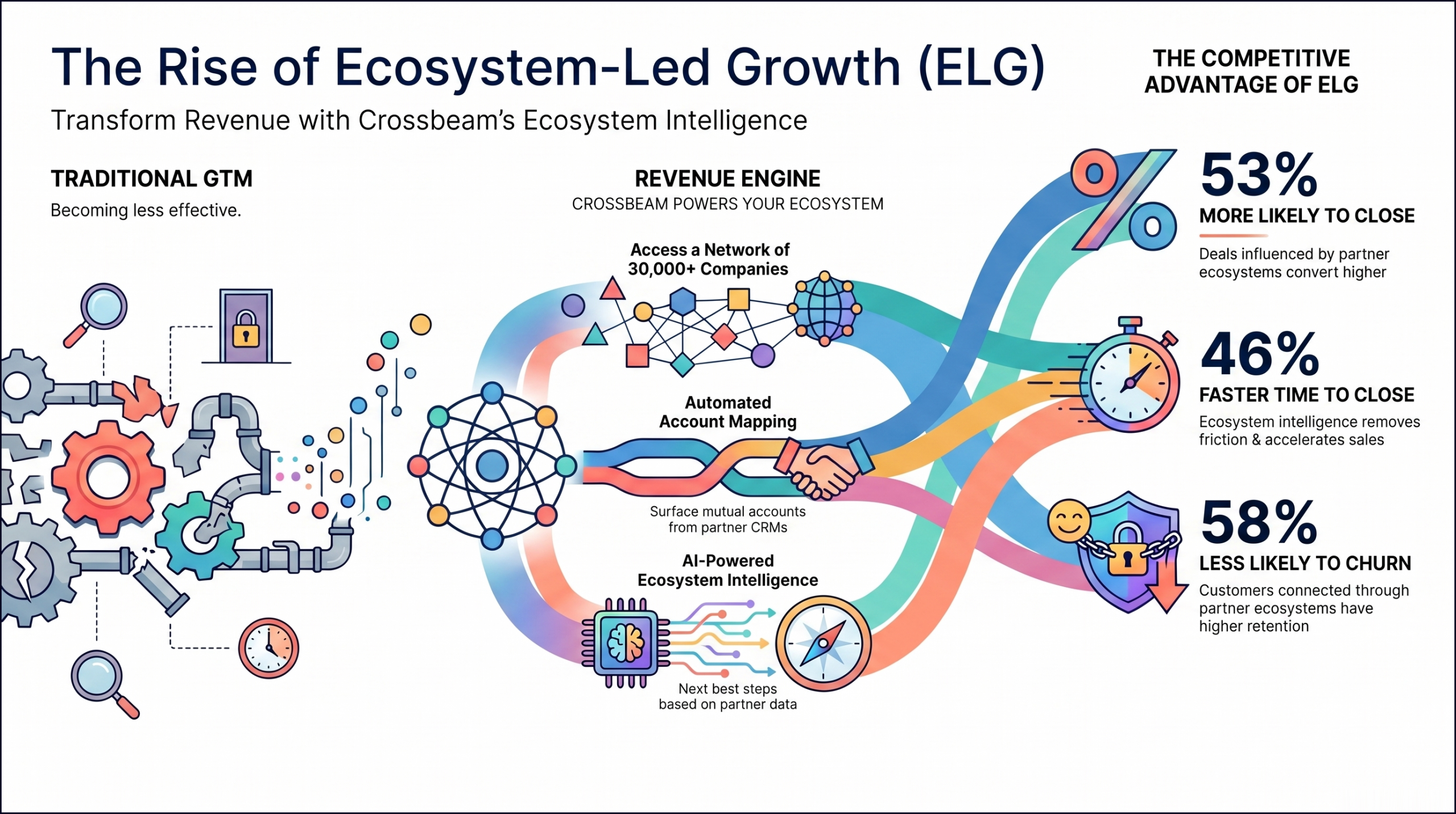
This isolation is why conversion rates are stagnating; you are trying to break into accounts where your partners already have the keys. Ecosystem-Led Growth flips this script, moving companies away from siloed tactics toward a collaborative strategy where the partner ecosystem is the primary driver of the revenue engine.
“The old GTM playbooks aren’t working. Ecosystem-Led Growth (ELG) isn’t just another buzzword—it’s a game-changing strategy transforming how companies attract, convert, and grow customer relationships by leveraging their partner ecosystems.”
This is more than a shift in lead sources; it is a shift in market philosophy. By moving from a “solo hunter” mentality to an interconnected network, companies can leverage established relationships to bypass the noise. ELG treats the ecosystem as a strategic asset rather than a secondary channel, ensuring that every move is informed by the collective intelligence of the network.
Takeaway 2: The Staggering Math of Ecosystem-Led Deals
The argument for ELG is grounded in the “holy trinity” of modern B2B SaaS metrics: win rate, sales velocity, and customer retention. When deals are ecosystem-led, the economic profile of the transaction changes fundamentally. The data shows that these deals are:
- Likelihood to Close: 53% more likely to close than traditional, non-partnered deals.
- Speed of Closing: 46% faster in terms of time to close.
- Churn Reduction: 58% less likely to churn over the customer lifecycle.
From a strategic perspective, these numbers represent a massive leap in efficiency. The 46% boost in velocity occurs because ecosystem-led deals leverage warm introductions and pre-existing trust.
You are not spending the first three months of a sales cycle proving your legitimacy; your partner has already done that for you. This “Sales Acceleration” effect is the only way to maintain a competitive edge in a market where buyers are increasingly skeptical of cold vendor claims.
Takeaway 3: Turning Your CRM into a Living Revenue Engine
The heart of ELG is a technological shift known as “Account Mapping.” Historically, partner data was trapped in static spreadsheets, leading to missed opportunities and “blind” territory planning. By transforming your CRM into an ecosystem revenue engine, you gain real-time visibility into your partners’ CRMs to uncover mutual prospects and “hot” deals that were previously invisible.
This requires a radical departure from the “data protectionism” of the past. In a winner-takes-most market, those who share data to find the “hot” deals win the race to the account. Collaborative growth allows you to see which prospects are already buying from your partners and which accounts are currently “heating up.” This visibility transforms the CRM from a passive database into an active intelligence layer, ensuring your sales reps are always focused on the path of least resistance and highest reward.
Takeaway 4: The Rise of AI-Powered Ecosystem Intelligence
The most sophisticated iteration of ELG is the move from manual data matching to automated “Ecosystem Intelligence.” Tools like Crossbeam Copilot and the use of AI Chat prompts are bringing ecosystem data directly into the daily tools used by sales and RevOps teams. This isn’t just about having data; it’s about having the “next best step” surfaced automatically.
Through the integration of Crossbeam’s Model Context Protocol (MCP), companies can now connect ecosystem intelligence directly to their own AI agents, Slack, and internal workflows.
This moves the ecosystem strategy from a manual exercise to an automated intelligence layer. Instead of a sales rep wondering who to call, AI-powered agents analyze the network and provide a specific recommendation: which partner to leverage, what the entry point is, and how to execute the play. This is the future of sales—data-driven, partner-validated, and AI-accelerated.
Conclusion: The Future is Interconnected
The era of the “lone wolf” software company is over. In a crowded, noisy market, the only way to scale effectively is to tap into the network effect of the 30,000+ companies already participating in the Crossbeam network. The path to sustainable revenue is no longer found in working harder at a broken outbound model; it is found through the interconnected power of your partner ecosystem.
As you look at your pipeline for the coming quarters, you must ask yourself: Is your organization still clinging to an obsolete, siloed playbook, or are you prepared to harness the collective intelligence of the most powerful revenue network in the world?