The End of Legacy IT: Why the JumpCloud + Google Workspace Collaboration is the Future of IT
The JumpCloud + Google Workspace partnership provides a unified, modern alternative that combines superior productivity, security, and flexibility, marking the "end of legacy IT".

 As they write here Jumpcloud announced a major collaboration with Google Workspace, introducing the Work Transformation Set.
This is a bundled, integrated solution designed to replace legacy IT systems, particularly those reliant on Microsoft tools like Active Directory, Entra, and Intune.
Legacy IT infrastructures are outdated, insecure, costly, and restrictive in today’s cloud-native, AI-driven world.
The JumpCloud + Google Workspace partnership provides a unified, modern alternative that combines superior productivity, security, and flexibility, marking the “end of legacy IT” and enabling true digital transformation without vendor lock-in.
The Work Transformation Set drives innovation through AI by integrating Gemini in Google Workspace to enhance productivity with features like content generation and data analysis, while JumpCloud provides centralized controls for secure access.
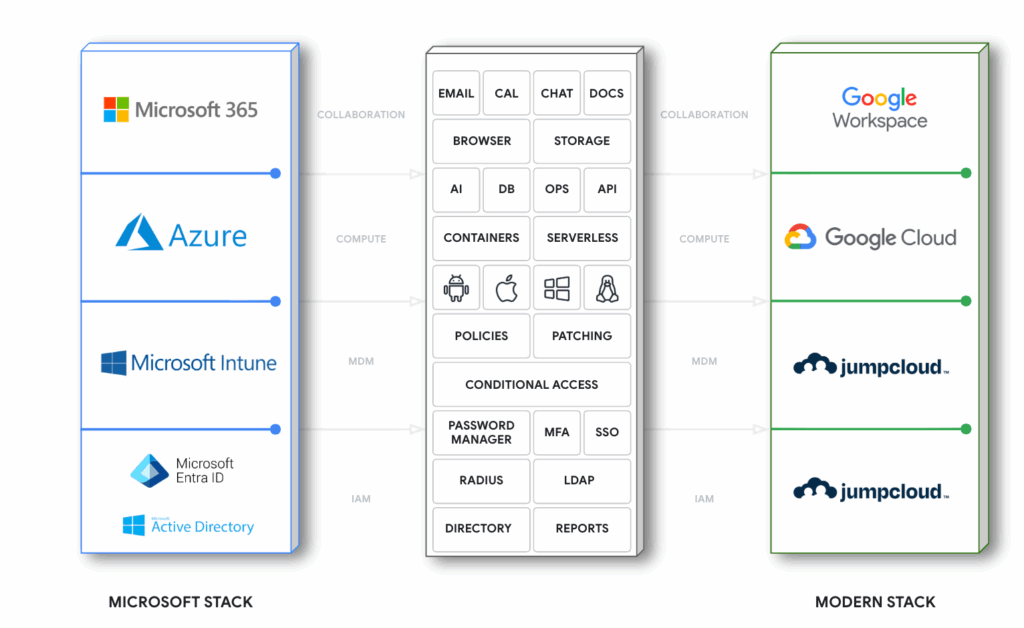
It delivers Zero Trust security by replacing vulnerable legacy systems with robust multifactor authentication, biometric verification, and device-agnostic controls that minimize attack surfaces. Additionally, it promotes agility and an open ecosystem by avoiding vendor lock-in, supporting cross-platform devices regardless of OS or location, enabling seamless third-party tool integrations, and reducing costs through stack consolidation.
Key Elements of the Partnership
- Google has selected JumpCloud as the recommended replacement for Microsoft identity and device management for customers moving away from Microsoft E3/E5 licenses.
- The Work Transformation Set integrates Google Workspace’s AI-powered collaboration tools (enhanced by Gemini AI) with JumpCloud’s cloud directory, identity management (IAM), and unified endpoint management (UEM).
- It’s offered exclusively through Google at a consolidated, cost-effective price.
- JumpCloud is already used by tens of thousands of Google Workspace customers, making it a natural complement.
For more details read their ebook.