Building a Profitable Microsoft Cloud MSP Practice: Opportunities and Strategies for 2026
Strategic Market Analysis and Product Roadmap Strategy for Microsoft MSPs

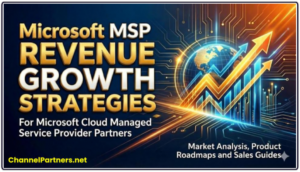 The Microsoft Cloud represents one of the most lucrative recurring revenue opportunities for managed service providers (MSPs) heading into 2026.
With organizations worldwide spending tens of billions annually on Microsoft 365, Azure, and related services, MSPs specializing in the Microsoft ecosystem are experiencing faster growth than those stuck in traditional on-premises or infrastructure-focused models.
The key to profitability lies in shifting to high-margin, proactive services centered on AI, security, hybrid cloud, and automation.
The Azure Opportunity: AI, Hybrid, and Optimization
Azure commands about 25% of the global cloud market in 2025, with its managed services segment projected to reach $13.2 billion by 2031 at a 13.2% CAGR. Enterprise adoption of AI, hybrid migrations, enhanced security, and cost controls are primary drivers. Virtual desktop infrastructure (VDI) and cloud PCs are particularly explosive, with the VDI market valued at $19.3 billion in 2025 and expected to hit $78 billion by 2032 (22.1% CAGR), while desktop virtualization grows from $15.3 billion to $25.2 billion by 2030. Gartner forecasts over 50% of virtual desktops will be cloud-based by 2028.
Key opportunities include Azure Virtual Desktop (AVD) for complex, multi-session environments (with GPU support and reserved instances) and Windows 365 for predictable, fixed-price Cloud PCs ($31–$66/user/month), ideal for SMBs. Hybrid work, zero-trust security, compliance needs, and AI-enabled endpoints drive demand, delivering 20–30% cost savings and productivity gains.
A major catalyst is the Windows 10 end-of-support on October 14, 2025, impacting 67% of users (versus 29% already on Windows 11). This creates urgent migration projects for enterprises and SMBs. Windows Autopilot enables zero-touch provisioning, slashing deployment time dramatically—saving roughly 1.8 workweeks per 500 devices and achieving a 98% cost reduction through auto-configuration on first boot. Tools like ControlUp Automate, Parallels RAS, and Microsoft Power Automate further halve deployment times, support auto-scaling, monitoring, remediation, and security enforcement.
Successful Azure MSPs pursue Azure Expert MSP status, leverage Microsoft co-sell programs and marketplace incentives, and specialize in AI transformation (using Copilot, Machine Learning, and Fabric), sustainability reporting, and industry-specific compliance. Targeting mid-market and regulated sectors in North America and Europe, they offer tiered services guaranteeing 15–20% savings via Azure Cost Management, reduced downtime, and accelerated innovation.
Intune: Securing the Dissolved Perimeter
In today’s cloud and remote-work era, traditional firewalls are ineffective, shifting security to identity- and device-based Zero Trust models. Microsoft Intune, integrated with Entra ID, verifies trust for SaaS apps and BYOD scenarios, focusing MSPs on policy management rather than hardware.
MSPs can pitch rapid onboarding (reducing from 18 hours to 3 via Autopilot), robust data protection (remote wipes without affecting personal data), and cyber insurance compliance through encryption, patching, and compliance policies. Mobile Application Management (MAM) containerizes corporate apps like Outlook and Teams for BYOD privacy. Compliance as a Service uses Intune policies (BitLocker, OS versions, antivirus) and Entra Conditional Access to block non-compliant devices, curbing Shadow IT and configuration drift via automated detection tools like Inforcer or CIPP.
Pricing typically bundles as per-user monthly fees of $125–$175, layering Microsoft 365 Business Premium ($22/user/month) with MSP tools and support for 60–70% gross margins. Multi-tenant management relies on orchestration platforms for standardization via “Golden Tenants” and configuration-as-code. Key tools include:
- CIPP (open-source or ~$99/month hosted) for GDAP and control.
- Nerdio Manager for unified AVD management.
- Inforcer for security baselines and drift reporting.
- Simeon Cloud (~$50/tenant) for DevOps-style backups and CI/CD.
- ImmyBot for endpoint software deployment.
- Microsoft 365 Lighthouse (free via Partner Center) for native oversight.
These deliver single-pane visibility, automated onboarding, and policy enforcement.
Microsoft 365 and Copilot: AI-Powered Productivity
Microsoft 365 boasts 3.7 million business users and 70% Fortune 500 penetration. It integrates seamlessly with AVD and Windows 365 for secure access to Teams, Outlook, and more in hybrid setups, especially in regulated industries. Copilot ($30/user/month) introduces AI enhancements, with “AI-enabled Cloud PCs” in public preview by November 2025, featuring natural language orchestration, “Click to Do” actions, and advanced search. Windows 365 for Agents deploys AI automation bots on Cloud PCs, integrating with Dynamics 365 for multi-agent workflows and yielding 20–30% productivity boosts (saving ~5 hours weekly per user).
MSPs monetize through Copilot tuning, low-code customizations, AI-ready migrations, API integrations, and Entra-governed agent management. Microsoft has boosted partner incentives by 50% for Copilot and Azure, tapping into the $15 billion+ desktop market and positioning MSPs as AI experts.
Scaling Through Automation and Standardization
Profitability demands automation beyond native tools, which suit single tenants but falter at scale. Third-party platforms enable efficient multi-tenant provisioning, monitoring, security, cost optimization, and reporting. MSPs evolve from manual processes to fully orchestrated operations, standardizing offerings for predictable costs and measurable outcomes.
Partner Program and Market Realities
The Microsoft AI Cloud Partner Program (MAICPP) replaces the old network with Enterprise/SMB tracks and designations in Modern Work, Security, and Azure Infrastructure. The Partner Capability Score (PCS) requires 70/100 points across Performance (net adds, low churn), Skilling (certifications), and Customer Success (usage growth). Benefits include free licenses (e.g., 5 Copilot, 200 E5), Azure credits, up to 30% rebates, and co-sell access.
The New Commerce Experience (NCE) mandates 12–36 month commitments with strict cancellation rules, requiring careful risk management via credit checks and diversified revenue.
Strategies for 2026 Success
Forward-thinking MSPs should:
- Prioritize high-velocity services: Intune/Autopilot management, Azure landing zones, backup/governance, AI/data services.
- Automate aggressively and standardize via tools and “Golden Tenants.”
- Achieve MAICPP designations and leverage incentives.
- Target buyer personas—Pragmatic Owners (SMB security), Innovation Seekers (mid-market AI), Compliance Guardians (regulated verticals like healthcare/finance).
- Use value-based pricing ($50–$150+/user/month tiers) and campaigns (e.g., “Shadow AI Wake-Up Call” audits).
- Address Shadow AI risks with Private AI via Azure OpenAI and Purview.
- Bundle Microsoft 365 Business Premium as the core SKU, upsell Copilot and security.
In 2026, the MSP market will split between legacy commodity players and “Frontier Firms” orchestrating AI workflows, governance, and security. By embracing automation, AI readiness, and strategic Microsoft partnerships, MSPs can convert disruptions into sustained, profitable growth in the intelligent cloud era.